This was the government that worked with the TWU to deliver “Same Job, Same Pay,” “Closing the Loopholes,” and Transport Reform.
This is not the only level of Government that looks to the TWU as stalwarts of industry reform. In NSW, the Minns Labor Government worked with the TWU to deliver significant reforms to Chapter 6 of the Industrial Relations Act to bring NSW transport legislation into the 21st century, creating new protections for Owner Drivers and recognising gig workers in NSW law for the first time. They also worked with the TWU to introduce job security provisions for waste workers.
None of these achievements happened by accident.Transport workers have a powerful voice in the halls of both Canberra, and Australia’s oldest Parliament at Macquarie St.
It’s now commonplace to see a couple of dozen truck drivers, baggage handlers, food delivery riders, employers and union officials walking through Parliament House.
At the beginning of September, TWU leadership took a transport delegation to Canberra to talk about the impacts of new laws on the industry so far, and what still needs to be done.
This government has sat down with transport workers time and time again to listen to what needs to change—and they’ve demonstrated that they’re willing to put that into action through passing transport reform, Same Job Same Pay and other crucial tools now at our disposal.
It was the first time we’ve brought road and aviation workers together to talk about the issues both industries still face.
TWU members were front and centre, speaking to dozens of parliamentarians including the Prime Minister and Deputy Prime Minister.
They heard from some familiar faces – like Steve Newton, an employee driver delivering parcels out to Dubbo, seeing sub-contractors taking risks like using rear trailer breaks because their bosses have told them it’s too expensive to change brake pads.
There are also newer stories, not just from trucking but from the gig economy, which desperately needs standards introduced.
Yaser, who’s a rideshare driver, has a wife and three children to support, and a mortgage to pay. But after his rates were cut again by Uber last year, he’s been working 14-hour days just to make the same amount as he was a year ago, and purchasing second-hand tyres because he can’t afford new ones.
The aviation industry is plagued by many of the same problems as road transport: a race to the bottom on standards and conditions, clients like Qantas splitting up the workforce and splintering workers’ power.
Ground handling workers in Canberra spoke about companies with broken or outdated equipment, where there was pressure to rush just to get planes out on time. It’s the same as what we’ve seen in road transport with the immense and deadly pressure to work fast enough to keep a contract.
Our calls on the Federal Government for a Safe and Secure Skies Commission now begin in earnest – and just like we did with road transport, we’ll keep up those calls until we see change.
Because as always, when we fight, we win.
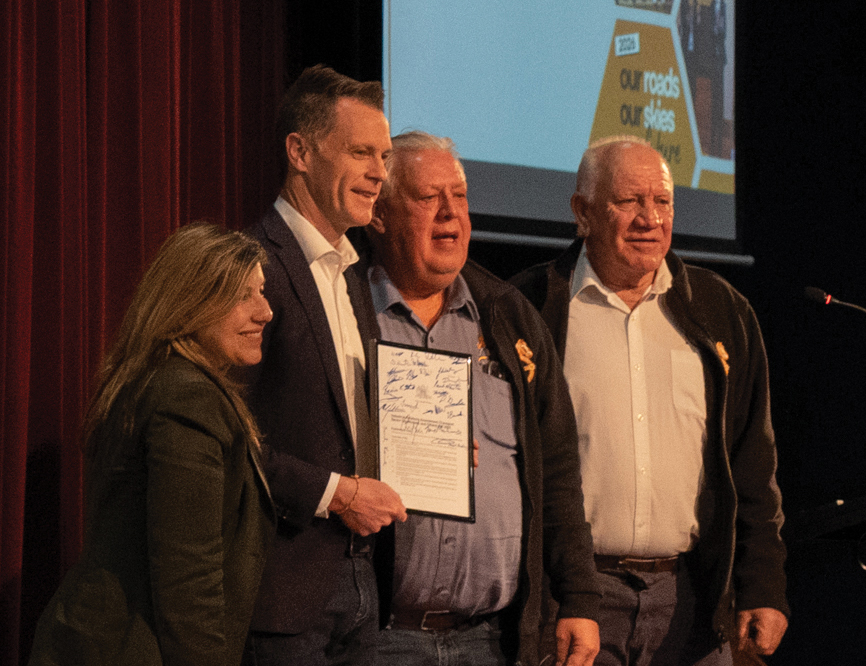

Above left:
Chris Minns hands Secretary Richard Olsen a signed-copy of the historic transport reforms that the TWU passed in the NSW Parliament.
Above right:
The Prime Minister listens to a TWU delegation to Canberra in September about protecting our recently won reforms, and the upcoming fight for 2026 (sporting a TWU orange tie).